Email Nurturing & Database Marketing — Part 1
What database & nurture marketing is, who you need on board, and how to steer it with the right KPIs — lessons from building Celonis' global email marketing team.
Originally published on LinkedIn
Part 1: What it is, who you need on board & how to steer it with the right KPIs
The power of database marketing & nurturing
The goal of your nurturing & database marketing is to supply your target audience with relevant content at the right time that provides value to them: being it to educate them further about your offerings, invite them to relevant events or to inform your customers about the newest product updates. Another important goal is to identify those leads that are ready to engage with your sales team.
Disclaimer: Although nurturing includes a wide range of channels and tactics, I will focus this article on how to use the email channel and email automation in particular, for nurturing.
With today's marketing technology it is possible to bring this concept to life in an automated way where your prospects will, upon agreement, receive hyper personalized emails
- based on their (persona) interests;
- with content that is targeted to his/her industry
- customized to his/her previous engagement and
- customized to his or her stage in the buying cycle.
In theory, this idea sounds pretty simple. In reality, it becomes complex once your company surpasses a certain size and e.g., when your company offers several products, operates in different regions etc. It's easy to get caught up in complex (theoretical) automation scenarios (anyone who has tried to conceptualize and explain an email flowchart with five steps and multiple decision paths knows what I'm talking about ;-)) instead of optimizing for the value that the recipients get out of your emails.
However, if you get it right, nurturing via (automated) email marketing will become one of your most important marketing channels as well as demand and revenue drivers. Particularly for companies with huge databases, it has the potential to be a real game changer at almost no cost.
To reach the ideal scenario described above you need to have a very clear idea not only on your target audience (ICP, personas etc.) and how you want to communicate to them but also of how you want to segment your database. In addition to that, you need to know how to govern your (automated) email marketing efforts and to comply with legal boundaries.
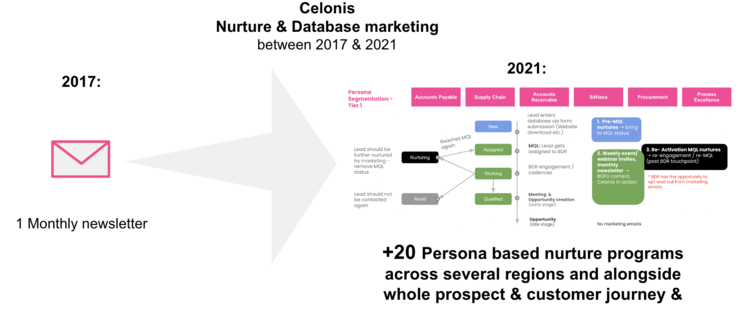
In the following article I would like to share my learnings about the topic database & nurture marketing based on my experiences building the global database marketing team at Celonis. Celonis sells its execution management software in the Enterprise market and is now with a valuation of more than 13bn $ the most successful German start up of the last decades. When I started in 2017, the company employed around 100 FTEs and I started as the first online marketing manager. By the time I left in 2021 we were around 1.5k employees and we had built a team that owned the email communication globally to a CRM database with hundreds of thousands of contacts. My learnings are based on leading our global email marketing efforts during this rapid growth period.
Part 1 of the article looks into the goals of nurture & database marketing, the right KPIs to look at and which talent to look out for.
What does lead nurturing mean?
According to Marketo lead nurturing “is the process of developing and reinforcing relationships with buyers at every stage of the sales funnel. A successful lead nurturing program focuses marketing and communication efforts, on listening to the needs of prospects, and providing the information and answers they need to build trust, increase brand awareness, and maintain a connection until prospects are ready to make a purchase.”
The term database marketing is defined as “the practice of leveraging customer data to deliver more personalized, relevant and effective marketing messages to both existing and potential customers” according to Optimove. Database marketing begins whenever a lead enters your database (web form submission, lead upload after an event. etc.). In theory, database marketing is one important part of your lead nurturing strategy, which heavily relies on the email channel.
Team structure, organizational fit & talent
In order to excel in nurturing via email marketing (automation) it is important to bring together 2 key skills:
- The ability to create an amazing email experience. This includes copywriting, creating a storyline, catchy subject lines and to have an eye for the design.
- A strong technical understanding of the underlying data points of your CRM to segment your audience and set up journeys and automation rules.
This combination of skills can rarely be found in one person - they are just too opposite. Therefore, it makes sense to look out for two profiles: A copywriter, in the best case specialized to short (email) copywriting and a more technical marketing automation manager (this is typically the name of the job, but could also be a marketing operations manager).
When you are a small company, it makes sense to have the marketing automation manager inhouse first and outsource the copy writing or have a content writer from your marketing team to support here. Why the automation manager first? Without the technical know-how to build email lists and conceptualize and set up your programs, it does not make sense to have a person specialized on email copywriting. In the worst case it does more harm than it creates benefits if you set up your journeys incorrectly. Paying external consultants for building your email programs will cost a lot and will make you dependent on them for future changes.
Once you grow and have several programs to oversee it makes sense to have a centralized database/ nurture marketing team, with both automation managers as well as copywriters that oversees all the database marketing & nurturing efforts for your organization. It is important to govern the email marketing efforts centrally for various reasons, but most importantly to be in control of the communication strategy as a marketing department and to be able to comply to legal requirements such as GDPR.
KPIs
My former boss Christoph used to say: "What you cannot measure, you cannot optimize". This might not always be true but I think it is especially true for database and email marketing.
So, which are the right KPIs to focus on to measure the success of your database marketing & nurturing efforts? Based on my learnings, I would advice to look at the following KPIs:
(PS: Don't over engineer the definitions. If you do, it will also be more difficult for others to understand them.)
Database KPIs:
Database growth
An important KPI for your database marketing efforts is the size and growth of your mailable target audience, meaning the number of contacts within your defined ICP in your database that you can reach with your marketing emails. When I talk about a mailable audience I don't mean contacts you bought via content syndication or contacts you dumped into your database via Outbound tools or similar. Mailable relates to those prospects that engaged with your marketing content and consented to receiving marketing emails.
This KPI is influenced by your lead gen / demand generation activities, so not directly by your email marketing team. But as the owner of your database (and as a CMO) you should have a close look at how it develops - this is the size of your playing field.
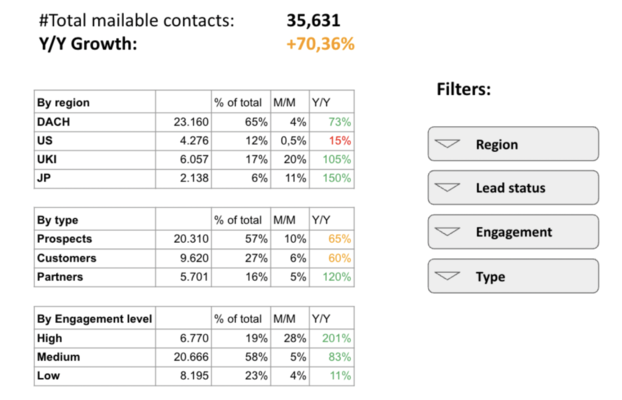
For me, the mailable database size is one of the cleanest marketing KPIs there is. It shows clearly how many warm contacts you can reach with a strong communication channel that you control (vs. e.g. 3rd party performance marketing channels). It is “pretty black or white” and it should correlate with the effectiveness of your demand generation efforts.
Break the mailable audience down to further dimensions such as region, personas, or lifecycle stage to retrieve further insights and report the M/M, Y/Y growth frequently.
Database engagement with your emails
Find a metric that reflects the engagement of your database with your marketing emails. This could be
- the % of contacts that clicked on at least x amount of links in your emails in a given time frame, or
- the contacts that surpassed a certain (email) scoring threshold. Be careful with email scoring and bot engagement (make sure to filter out bot engagement for this metric).
Then, split your database into an engaged and unengaged audience, or define segments of engagement levels, e.g. low engagement, medium engagement and high engagement (see Graphic 1).
The combination of both, your mailable audience and the engagement of your mailable audience, will show you if your database and email marketing efforts are going in the right direction, or not.
Growth of your opt outs
Similar to the growth of your mailable audience you should also monitor the growth of your opt-outs to identify negative trends, e.g. sending too many emails or sending the wrong emails at the wrong time.
Program goals - MQLs, SQLs, pipeline, revenue via nurturing
When you set up a nurturing program (a sequence of automated emails and other marketing activities based on triggers/ activities of a prospect), it should always be designed to achieve a (measurable) goal - being it to educate your leads further, to achieve more sign ups for your webinars or to schedule more sales calls.
One example could be that you set up a nurturing program for leads after they signed up for your free trial. You want to educate them about how to use your product and to hand over those leads over to sales who want to learn more about your pricing. Your success metric for such a program could therefore be #of users who concluded a certain activity during the trial or the #sales calls booked after leads entered the nurture program.
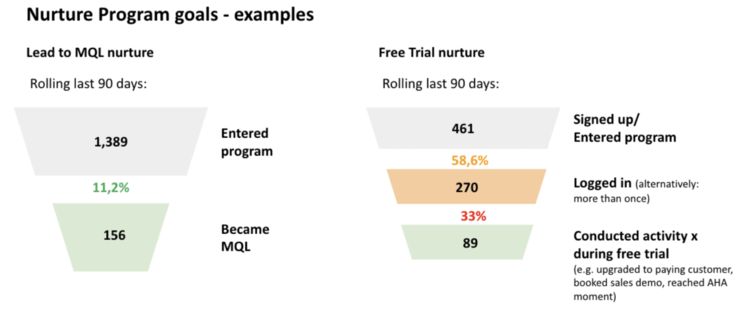
Another use case could be that you want to re-engage with customers in your database that have not shown any engagement for a while. After you have identified those customers, you set up a program for this segment to re-engage with you and to learn about your newest product updates in one of your monthly customer webinars. The program goal for this re engagement program could be to measure how many customers of this segment signed up for the webinar.
Further key questions you want to answer with your program goals:
- How many prospects did I convince to engage in a defined activity (e.g. sign up, user action in my software etc.)?
- How many leads went through your nurture programs and became marketing qualified (MQL) and thereafter Sales qualified (SQL)?
- How many of them turned into opportunities and actual sales?
- How can I tweak, personalize and optimize my program / emails in order to increase conversion rates?
Email engagement KPIs
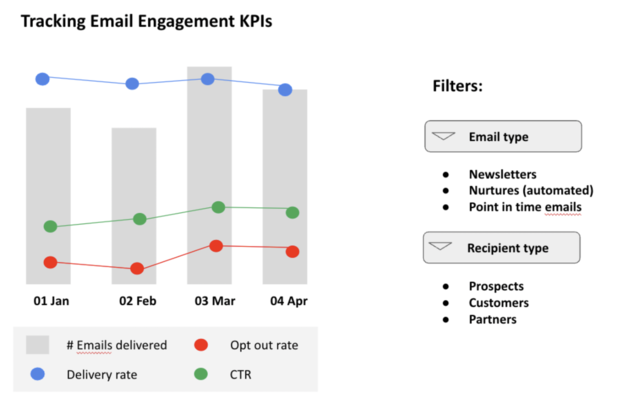
The KPIs mentioned above are the ones that show on a high level if your nurture marketing efforts are successful or not. On a more micro level it is important to have a close look on the performance metrics of the single emails a nurture program consists of, i.e. delivery rates, open rates, click to open rates, opt out rates etc..
These will show you which of your emails are working well and where you might need to adjust the length of your programs, switch email contents etc. Use A/B testing to improve your emails and to understand which subject lines, which content, CTRs etc are working for you.
For me, the most important email engagement KPIs to look at were the delivery rate (shows the quality of your audience), CTR and the opt out rate. You can find good benchmarks for the SaaS industry on campaign monitor. Besides comparing yourself against those industry standards, I recommend to mainly focus on improving your own email engagement KPIs.
I also recommend that you have your email marketers report on A/B testing results. Each of the A/B tests should have the goal to improve one of the KPIs mentioned above.
Summary:
The goal of your nurturing & database marketing is to supply your target audience with relevant content at the right time that provides value to them. In order to excel in email nurturing and database marketing you need the right talents - the ones creating amazing email experiences and the technical masterminds bringing them to life technically - and you need to know which KPIs to look at. This article gives you a suggestion for a strategic KPI framework from the CMO / database marketing lead perspective.
Keep in mind: All of the KPIs I describe will always be “only” numbers and you should therefore never forget the actual content and strategic thoughts behind those numbers. What they do help you with is to improve your efforts: The better the emails and the more relevant they are (right time, right content), the higher the CTR and the higher the conversion into your program goals. It is as simple as that. The better your lead generation and marketing campaigns are, the more likely you will see a growth of your mailable audience. And the better your nurture marketing programs, the higher the impact on your revenue.
I hope this can be helpful for other young B2B marketing professionals who are thinking about building their email nurture strategy. Reach out me if you have any questions or comments!
Part 2 of my article will focus more on how you can segment your database and build the right governance for your email marketing efforts, as well as my personal learnings. Furthermore, I will give a suggestion for a potential framework that you can use for building your nurture strategy. Stay tuned!
This article was originally published on LinkedIn. Read the original version, leave a comment or share it directly from there:
View on LinkedIn