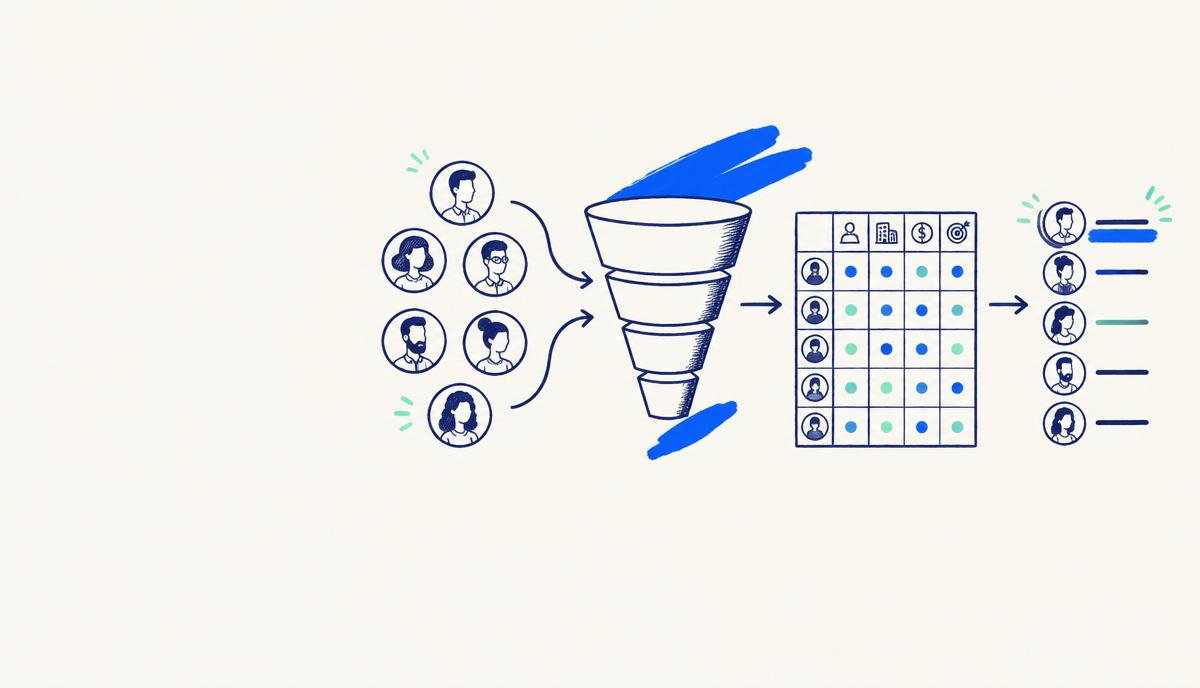
Email Nurturing & Database Marketing — Part 2
How to segment your database, build governance for your email marketing efforts, and design nurture flows that scale.
Originally published on LinkedIn
Written for series A to series C SaaS companies
For whom this article can be relevant: VP/ Head of Marketing, Database marketing lead, Marketing automation manager.
In part 1 of this article, I talked about the perfect setup and managerial monitoring of your database & nurture marketing efforts: What it is, who you need on board & how to steer it with the right KPIs. Part 2 of my article will focus more on how you can segment your database and build good governance for your email marketing efforts, as well as my learnings. These learnings are based on my experiences leading the global database marketing team at Celonis. Let's dive into it:
Database segmentation
To provide relevant content to the contacts in your database, you need to collect relevant information about them. Which data you should collect will highly depend on your product offering and your Go To Market strategy that guides your overall sales and marketing efforts.
At Celonis, we were selling (and therefore marketing) primarily to large enterprises in all verticals and across several different use cases. Each use case corresponded to different business processes that could be analyzed, optimized, and intelligently automated with Celonis - an important use case was for example, order to cash). The buying decisions were made by higher leadership or even at the executive level; and therefore, some of the most important information to collect was:
Company information:
- Company name
- Employee size
- Annual revenue
- Industry / vertical
- Type of relationship with your company (partner, existing customer, prospect, etc.)
Lead information:
- Name, Email
- Job title/job hierarchy level
- Department
Engagement information:
- Engagement with our marketing campaigns (attended which webinars, downloaded which ebooks, etc.)
- Email & web engagement
Think about where in the buyer's journey you best collect which information and where you can use intelligent matchings or data enrichment tools, e.g., company information such as the number of employees or annual revenue can be stored in your CRM and does not need to be collected with each form submission. Furthermore, you can also use progressive profiling \- adapting your forms based on the information you already know about the contact - so you don’t ask the same information twice but rather ask a new question. This will enable you to collect more relevant information with each form submission, while keeping the form short. And since we know that the more information you ask in a form, the lower the conversion rate of such form - it makes sense to split the collection between several forms.
The data you collect will be the foundation for your ability to segment your database and to build dynamic lists (lists that are changing with the underlying information), which can be used for your email marketing and nurture strategy.
These are the dimensions that you should consider for your email marketing strategy*:
- Lifecycle stage: In which stage of your internal sales cycle is your prospect?
- MQLs: Use scoring & grading to define whenever a prospect reaches the point to be handed over to sales.
- Opportunity stages (If the prospect advanced into a sales opportunity): How advanced is the deal? When should you stop interfering with marketing communication not to harm the deal?
- Region: Where is the prospect based? Which of your regional sales/ partner/ CS teams is the owner of the prospect?
- Engagement: How interested in your product or services is the prospect? Use scoring to define engagement buckets (low, medium, high engagement).
- Email subscription (status): To which emails is the prospect subscribed to and what is their email subscription status?
- Personas: Classify your prospects into personas if possible. The information needed to segment prospects into personas (e.g. job title) depend on your persona definition
- Use cases: What are potential use cases that your prospects could be interested in?
- Industries: In which industry does the prospect fall into?
To summarize:Your (email) automation and degree of personalization will only be as good as your underlying data. Therefore the governance, enrichment, and cleaning of the data in your database is a key effort your database marketing team needs to take care of.
A tip for your marketing automation manager: I would advise you to build a standard set of regional dynamic lists for your most important email use cases. The same goes for email suppression lists. Use a good folder structure plus a standard naming convention and enable anyone who can send emails. Nothing is more annoying than building new lists for every email or ending up in a list chaos. For these reasons, the list building should only be owned and governed by your database marketing team.
A framework for email nurture programs in SaaS
The right segmentation is the foundation for your email nurture efforts. Now let's talk about the email nurture programs (automated email sequences) and how to set them up.
Of course it is hard to generalize advice on how to set up your programs. Companies, the needs of their target audiences, buying cycles, etc., are just too different. Nevertheless, here are some thoughts we considered when creating our nurture programs at Celonis.
On the highest segmentation level, we differentiated between partners, existing customers & prospects.
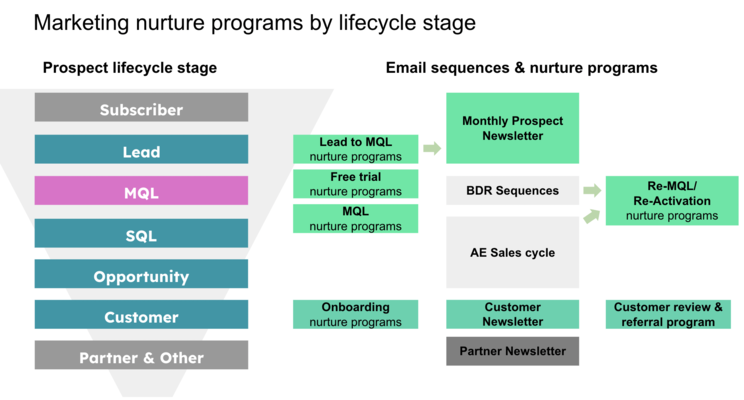
The second layer that defined our programs was a contact's lifecycle stage. E.g. for prospects, we split our programs between
- Lead to MQL programs \- email journeys after initial marketing touchpoints (e.g. whitepaper download) that had the goal of bringing a prospect to become marketing qualified
- MQL programs \- programs to keep prospects engaged while sales reaches out to them (here as with all other programs you need a very close alignment with your sales teams)
- Re-activation programs \- Programs after a sales interaction for those leads that were generally interesting for us but not yet ready for a sales conversation. Programs were designed to re-activate those leads after a while to check whether something had changed regarding their readiness
- Customer onboarding programs: Programs with tips, relevant resources & tricks that help your signed customers to onboard themselves into your product.
- Customer referral & upsell programs: Programs that reach out to your happy customers to generate reviews and customer referrals.
We then used the persona field (based on job titles) to divide our nurture programs - we had a Lead to MQL program for the order to cash use case, for the procurement use case, and so on. Inside the emails, we used the industry field for dynamic content (content that will be personalized for the recipient based on the field in your CRM).
What is the reasoning for splitting our programs into use cases vs. industries? The challenges we solved with Celonis are more similar between procurement departments in automotive and pharma than the challenges between a procurement department and supply chain management from the same industry.
Think carefully about how many programs you will end up with and if the complexity will be worth the effort to build and maintain those programs (the program list size needs to be big enough). With three segmentation layers alone, you can quickly do the math on how many different email programs you end up with if you would have five regions, ten personas, and ten industries you are potentially serving. To avoid suddenly having hundreds of programs to manage, you should use dynamic contents within the email copies instead (of new programs) where applicable.
Programs & emails outside your funnel nurturing
Automated nurtures are great but how do I fit my newsletters into them you might ask? And what about all the other emails that are being requested constantly? As a practitioner you know that there will always be a need for emails that will not fit into any automated structure. Examples of email (paths) outside our prospect nurture paths are
- Newsletters (partner, prospect, customer & product newsletters)
- Point in time emails: emails that do not fall into any of the categories mentioned above. Examples are invitations for specific events, product announcements or messages from the CEO
As the database & nurture marketing owner, you should have a good idea of how those emails fit in, not only for you as an internal service provider but also from the prospect perspective. So how bringing all of this together? My advice: Steer the internal demand for point-in-time emails with a straightforward request process and bring together the internal and the prospect view with an email preference center.
Email request process
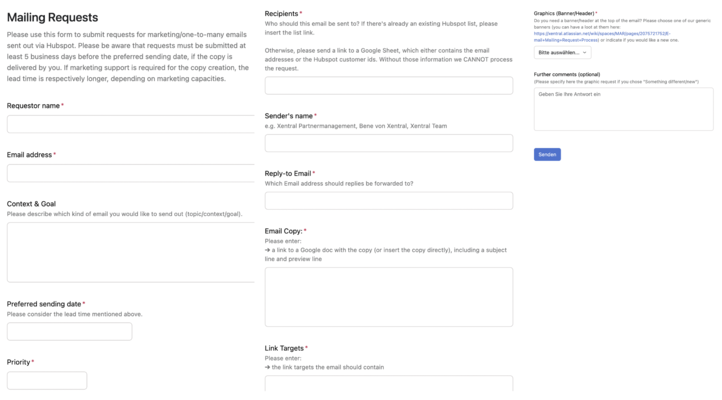
Establish a process and clear rules for point-in-time emails. Otherwise, it gets messy with last-minute email requests and very difficult to plan your team's resources. We are using this simple form with the following questions and a Kanban board in the background to show the (approval) status of the email to the requestor:
Email preference centers
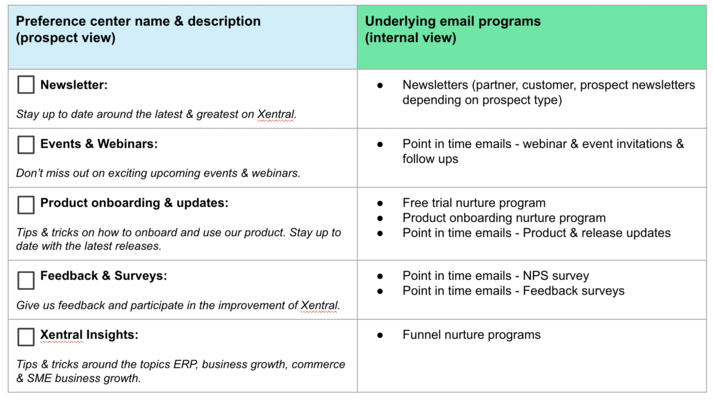
Email preference centers are the way to bring your email programs/ categories together with the user preferences. Name the preferences in a way that is understandable for your target audience and advertises the value of the emails they would receive when subscribing to the particular email type. These are the preference centers we are currently using for Xentral:
The nurture program set up
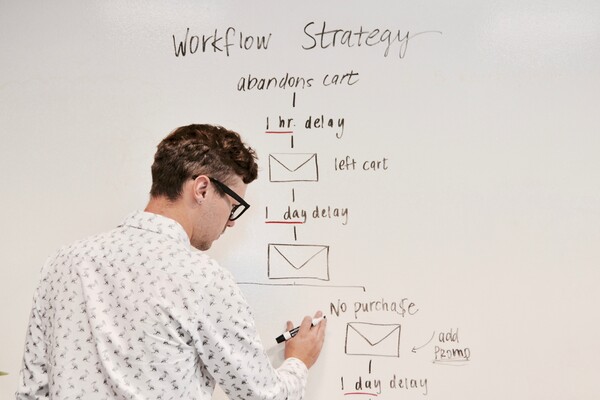
Now that you have thought about the bigger structure of your programs, the actual work begins: The program set up is the part in which you think about the email journey, the content & copy of the actual emails and when to send which email. Typically, an email nurture program is modeled with a decision tree like this:
The process of getting to the final program will involve the following steps:
- Email journey: Map out the email journey: How many emails should the program consist of? Where do you divide the email journeys, and which criteria are used for the decision trees?
- Content mapping (goes hand in hand with the email journey): Which content provides the most value at which point? Where does which content fit best in which email of the journey?
- Copywriting & design: The actual email creation: What is the tone of voice and which email banners are we using?
This is your marketing automation manager's domain. He or she should be the expert and owner of the nurture program setup and work with your content team to define the email journey. Trust their expertise to build the right outline and challenge them on the program's complexity, measurability, and content.
Tip 1: Use the most important segmentation criteria to build segmented programs, e.g. a lead to MQL program for each of your personas. This will help you to compare performances easily. Do not build everything in one program! And do not make the program unnecessary and overly complex. The risks of making mistakes are much higher and no one will understand anymore what's going on (especially hurtful if the person who set the program up leaves the company).
Tip 2: Base the email frequency and timing of the email based on the previous engagement. The “waiting up to X days” function will time your frequency based on engagement and will help you simplify your program.
Governance for your email nurture marketing
We talked about the segmentation, program set up, etc. until here. So are we ready to go? Not yet: One important aspect of email marketing that cannot be forgotten is how you govern it. The bigger the size of your company and the individual need to send marketing emails, the more important this topic becomes. Why is it so important?
- Database marketing involves processing personal data and is therefore subject to laws and regulations.
- At a certain growth stage you will have several other departments interested in using email marketing for their interests. Examples could be the product team that wants to inform the software users about new features or the partner management team that wants to implement a partner newsletter. There need to be rules & processes for how and when emails can be sent.
- It is a bad user experience if your prospects receive a partner newsletter, an invitation to a webinar, and product news simultaneously.
- You, as the database marketing owner, need full visibility of what is going on in all your email programs. It should be clear in which email programs the leads enter, when they move on, that there are no overlaps, and so on.
- You need to ensure that the right suppression lists are being used.
- You want to ensure a consistent brand experience and tone of voice across all emails.
- Most importantly: You do not want to give away the authority to send out emails from your marketing automation tool or, even worse, that other departments start using their own email tools that do not communicate with your marketing automation tool (you will end up with serious problems on monitoring opt-outs etc.).
All these topics should be addressed in a framework or similar official document that can be shared within your organization. At Celonis, we developed an email marketing framework with the following chapters to share internally and to use as a guide for all email marketing efforts in the company:
- Why email marketing governance is important
- When to use email marketing
- What email programs do we run: Prospects, Partners, Customers
- How do we govern email marketing programs?
- Who is eligible to receive emails? (per region, created in collaboration with the legal department)
- Preference center & suppression lists
- Data governance & deletion of data
- Email request process
- Reporting & KPIs
Create this document (!). It will save you so much time to explain, argue & prioritize emails, what the lists should be, etc.
My learnings on the topic nurture & database marketing
I started my career in B2B SaaS as a marketing automation manager. I had the chance to build the database marketing team for the most successful German startup of the last decade. I turned from a doubter into a believer and understood that email marketing and nurturing can be a key driver of engaging your target audience and driving demand.
Here is a summary of my most important learnings on this journey:
Email marketing needs to be incorporated into your overall marketing & campaign strategy
Do not think about email marketing as a standalone channel. Always incorporate it in a bigger marketing (campaign) strategy. My advice: Work with your campaign team and performance marketing counterpart on a joint ideal buyer's journey to outline at which point of a campaign someone enters your email sequences and how those will fit into your bigger nurture framework. The user journey brings me to my second learning:
The user journey that you draw does not exist
What you draw out on your whiteboard is something like: Someone sees an ad and then submits a form on our website for our whitepaper. We will send the first email and if someone clicks on that email we will send the 2nd email and if they then download the second whitepaper in that email we will send them the invitation to our next webinar and if that someone joined the webinar you invite them to a sales meeting which would be the main goal of your program. For every person who receives the last email in your automated journey, you have lost 99. Therefore, be aware of my following learning:
The attention is highest at the point of interaction and declines with every email
Engagement in your email programs decreases with every email. The moment when someone engages with your content or enters your database is the moment when you have the person's attention. This is the time where your email is most effective so use it wisely with your best and most personalized content to build up on the interest.
Keep in mind that, before consenting to downloading something and to receiving your emails, there probably has already been a long journey in which the lead has seen your ads, visited your website several times, etc.).
My advice: Focus on the first two emails that trigger after a prospect engagement. Include your best-performing content or your main CTA instead of waiting for the assumption that you are “building up the engagement” with your email stream.
The emails that come after the first three, maximum four, should serve more as reminders or to get eyeballs on your brand, so the lead does not forget about you. Define a point when you stop sending emails, as you also do not want to come across as too aggressive.
Email marketing is not dead.
I doubted the email channel, as I'm not the biggest consumer of marketing emails. Also, you read many articles about alternative channels that are supposed to perform much better, e.g. nurturing through performance marketing or chatbots. It might be true that other channels are working better for your company and as I mentioned before, your email marketing efforts should be always an integral part of your marketing campaigns but email marketing is definitely not dead.
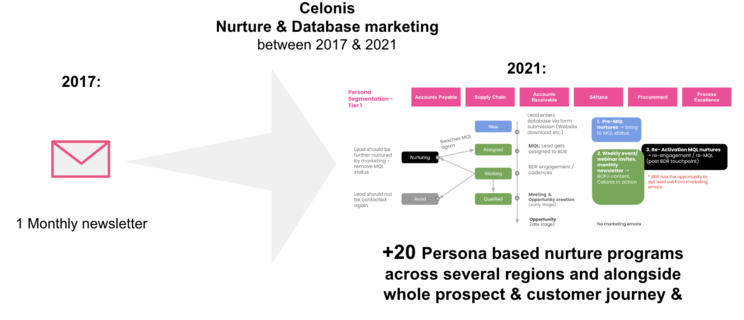
At Celonis, our marketing emails became one of the most important marketing channels, especially for driving prospects to events and webinars. Through constant improvements via A/B testings, we achieved incredible results such as +6 %CTR across more than 170k mothly email sends or driving +1,600 registrations to our signature event Celosphere 2020 via email alone. This was simply mind-blowing to see, as we had started with a single newsletter with 1k recipients in 2017. The result of my personal reflection of this journey is written down in this article.
I hope I could give some inspiration to achieve similar things and write your own success story with the amazing email marketing channel.
PS: Please reach out to me if you have any questions, comments or just want to chat about this topic.
Photos:
- Melanie Deziel on Unsplash
- Campaign Creators on Unsplash
*I’m using prospect here as a synonym for partner, customer & potential customers. You can use the segmentation criteria for any of them.
This article was originally published on LinkedIn. Read the original version, leave a comment or share it directly from there:
View on LinkedIn